Your result is
Nervous System Understimulation
Your neurobiological tendency is anxiety from insufficient activation, suppressed purpose, and misused neurochemistry.
Let's do something about it
This is what happened.
This tendency of anxiety expression occurs when the nervous system does not receive enough meaningful stimulation through purpose, novelty, or challenge, leading to a paradoxical state where anxiety coexists with low engagement.
Neurobiologically, insufficient dopaminergic activation (dopamine being essential for motivation, reward anticipation, and goal-directed behavior) creates internal agitation rather than calm.
When life feels repetitive, overly safe, or disconnected from authentic drives, the brain compensates by generating mental activity: rumination, perfectionism, overthinking, and overdreaming.
Anxiety here is not caused by excess stress, but by unmet potential.
Your anxiety doesn’t come from doing too much.
It comes from not being activated enough by what matters.
Your nervous system is under-stimulated at a meaning and challenge level, so it compensates with overthinking, perfectionism, and mental restlessness. When dopamine isn’t adequately engaged through purpose, novelty, or self-directed goals, the brain creates internal noise to stay awake.
This pattern is common in people who learned to suppress intensity, creativity, ambition, or emotional expression to fit external expectations, often activating through thought instead of action.
The problem is that thinking replaces movement, which further reduces dopaminergic reward loops and keeps the system stuck.
Resolution does not come from calming techniques, but from strategic activation: introducing novelty, risk, meaning, and self-directed challenge that restores healthy dopamine signaling and re-engages the nervous system.
Some examples of how this manifests is: procrastinating through over-planning, fantasizing about future lives instead of acting, feeling anxious yet bored, being perfectionistic to the point of immobility, or feeling restless despite having “nothing wrong.”
This is not a lack of discipline.
It’s a lack of aligned activation.
What helps is strategic challenge, novelty, and purpose-driven action that restores healthy motivation chemistry.
Your next step is you don’t need to calm down.
You need to move toward something real with precision, not pressure.
Okay let's do it thenBecause you are high functioning over achiever, let me show you how you can not only keep this at bay, but use this to your advantage.
Anxiety isn’t a single condition.
It’s an expression of how the nervous system is interacting with dopamine, cortisol, sensory input, rhythm, and meaning.
Some nervous systems suffer from under-activation.
Others from over-activation.
Others from living in environments that don’t fit their biology.
That’s why generic advice fails.
Breathing exercises don’t fix under-stimulation.
Productivity hacks don’t fix over-stimulation.
Mindset work doesn’t fix biological mismatch.
You don’t manage anxiety by trying harder.
You resolve it by aligning biology with behavior.
That's why calming tools often stop working.
Because they focus on reducing symptoms, not correcting the system.
-
Under-stimulated systems need activation, not soothing.
-
Over-stimulated systems need regulation, not pressure.
-
Incompatible systems need redesign, not discipline.
When the wrong tool is applied, anxiety either persists or morphs into another form—burnout, procrastination, numbness, or chronic restlessness.
The goal isn’t calm.
The goal is functional regulation.
Now I'm going to present you with an enticing offer so you cant start to build this resiliency.
Because most tools treat anxiety like disobedience.
Your system isn’t disobedient. It’s adaptive.
What’s missing is training, not suppression.
Okay I want to do itThis combo of 3 of hypnoses is a solution.
Anxiety is not primarily a thinking problem.
It’s a patterned physiological response.
Long before modern therapy models existed, hypnosis was used to work directly with conditioned fear responses, attention narrowing, autonomic nervous system regulation and habit loops stored below conscious thought.
Because anxiety lives beneath language, it doesn’t fully respond to insight alone.
Hypnosis works by accessing the same neural pathways involved in:
-
habit formation.
-
threat detection.
-
emotional memory.
-
attentional gating.
In other words, the systems that create anxiety.
This is why hypnosis has been used for over a century in clinical, medical, and performance contexts—not as mysticism, but as a way to train the nervous system when willpower fails.
Why a triad of hypnosis and not just one.
You don’t experience only one tendency.
You experience a dominant one, with the others layered underneath.
Biologically, these tendencies work in tandem.
- Under-stimulation leads to over-activation to compensate.
- Over-activation leads to shutdown and disconnection.
- Disconnection increases sensitivity to environmental mismatch.
That’s why treating just one pattern never holds.
You need three targeted hypnosis sessions that work together to:
-
Train awareness so you notice your pattern earlier.
-
Restore flexibility so you can adapt efficiently.
-
Prevent high-functioning self-sabotage when pressure hits.
If you only work on one, the others compensate, symptoms shift instead of resolving and progress plateaus.
That’s why people feel better temporarily, then revert.
The triad exists because the nervous system learns in layers.
All three interlocking systems need to be managed:
-
Activation (dopamine and drive).
-
Regulation (parasympathetic access and recovery).
-
Orientation (how the brain reads time, environment, and safety).
But this is not about staying connected to your body at all times or always in a calm demeanor.
You do need to disconnect sometimes to perform, fear is functional, and that spicy uniqueness to your personality should not be tamed.
Instad, what you get here is to notice where the boundary is so that useful disconnection turns into high debt and long-term damage.
Here you will be able to “use anxiety to you advantage”.
This means you still feel intensity, still care, still push but anxiety no longer decides how you move.
That’s the difference between ambition that costs you and ambition that compounds.
It means:
-
Noticing activation before it escalates.
-
Responding instead of reacting.
-
Allowing anxiety to inform decisions without controlling them.
Otherwise when anxiety is active attention narrows toward threat or urgency, perception becomes selective, the body prepares for action or avoidance and behavior becomes reactive, not deliberate.
Most high-functioning people learn to override these signals to keep going.
That’s useful.
Until it becomes automatic.
Over time, the nervous system learns “this level of activation is normal.”
At that point, anxiety is no longer episodic.
It becomes background operating system behavior.
Hypnosis intervenes at the level where those patterns are learned and reinforced.
I want to do themThis is the content of each hypnosis.
Even if you identify strongly with one tendency, you need all three.
Because life will activate all three patterns at different moments.
Anxiety-free activation
Regulated drive
Biological alignment
Why this works even when you’re not “trying”.
Meditation asks you to regulate from the top down.
Hypnosis works from the bottom up, through the nervous system, so they don't rely on effort.
Hypnosis work below conscious effort.
-
It trains neural pathways instead of managing thoughts
-
It changes pattern recognition, not just emotional state
-
It doesn’t require focus, discipline, or belief
It works through repetition, pattern exposure and subconscious learning.
You can listen while walking, cleaning, washing dishes, walking your dog, getting ready or lying in bed.
I mean you can even press play as you set up the snacks for a night of binge watching Stranger Things.
Because your nervous system doesn’t need full attention to learn.
Even partial attention allows the subconscious to absorb patterning.
Repetition, not intensity, is what rewires.
It needs consistent input.
That’s why these are short (10–12 minutes).
They are long enough to induce state change. and short enough to avoid resistance.
Your nervous system learns best in short, repeatable exposures.
-
Long sessions increase resistance in high-functioning brains.
-
10–12 minutes fits ultradian learning windows.
-
Short sessions allow use without ritualizing.
You don’t have to sit and meditate.
This is training, not performance.
Nobody cares that you do this everyday.
You are the one that needs to feel this is sustainable and adaptable to your lifestyle.
BuyThis is the next level because it is not trendy.
Instead it’s foundational.
It's a deeper change than the new shiny and viral practices of self-care you see out there.
Most people try to build a better life on top of the same wiring.
This work changes the wiring first.
So whatever you build next costs less, lasts longer and actually feels like you.
Anxiety doesn’t disappear.
It integrates.
And that’s how high-capacity lives stay livable.
I want it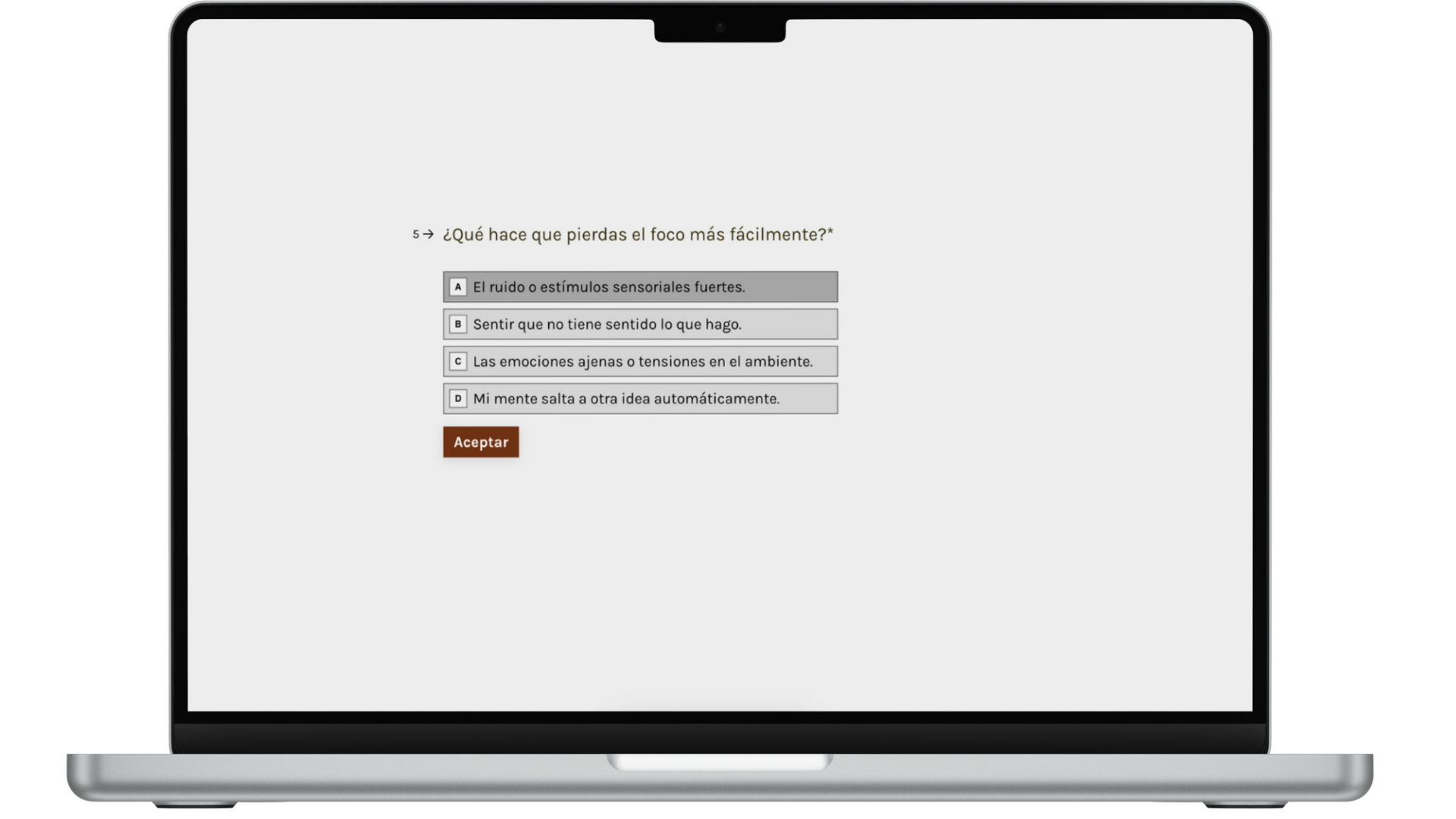


Hypnosis Triad
$47 USD
3 Online Hypnosis
[Reg. $75 USD]
- Test diagnóstico de tu estilo biológico de atención, lo que le interrumpe, lo que necesita y posibles problemas cuando dispersa.
- Test para saber la herida de autoestima dominante que no te deja avanzar. No es para encasillarte ni para que tengas otra etiqueta emocional. Es para saber por qué la fatiga, la duda, el perfeccionismo, la sobrecarga emocional o la hiperempatía surgen cuando te mueves en terreno nuevo y ambicioso y puedas resolver el conflicto interno y de roles producto de subir de calidad de vida. Hay 5 posibles diagnósticos y cada uno trae la raíz exacta, lo que está drenando tu energía y distorsionando tus decisiones y un audio (aprox. 10 minutos) para no solo nombrar la herida, sino mostrar cómo se alivia en el cuerpo y la mente de inmediato, sin tener que hacer terapia por cinco años para saber cómo se hace.
- 6 Clases online pregrabadas con la nueva forma de tratar y cuidar la atención sin necesidad de irte a vivir a un bosque ni dejar el mundo moderno para que puedas enfocarte como una persona de alto rendimiento, lo que eso signifique para ti.
- 5 Clases online pregrabadas con la novedosa y testeada manera de potenciar el autoestima considerando lo de más alto impacto.
- 1 Clase online pregrabada de 73 minutos con el protocolo de desinflamación por ansiedad según los estadíos y entendiendo de donde nace este miedo atrapado en el cuerpo y mente y qué hacer para que no uses el parche de "respira y deja que pase".
- Taller práctico ya grabado de 1 hora 43 minutos (parte 1) y de 1 hora y 48 minutos (parte 2) con foco en rabia encapsulada, inflamación sostenido e impacto en el cerebro y conducta y un protocolo de protección de nervios y ansiedad aplicada a diferentes contextos.
- Guía "3 Pasos para subir tu confianza y tener como base el anti-pseudo autoestima" (PDF) donde en vez de afirmaciones o journaling genérico que solo sirven cuando estás sola, vamos a enfocarnos en las fases paso-a-paso para sentirte más competente en una área ambiciosa que aún no has dominado y hacer un poco de neuroplasticidad superando cuando te quedas atascada pensando en la cabeza mientras terminamos con cómo crear un entorno social que te sostenga en ese nuevo nivel.
- Acceso inmediato a todo.
What the three hypnosis actually do (in real life).
1. Activation Without Anxiety.
This trains the nervous system to initiate action without threat chemistry.
Day to day, this looks like:
-
starting tasks without waiting for pressure.
-
acting before overthinking hijacks momentum.
-
feeling internal pull instead of mental push.
This is especially critical for people whose anxiety shows up as procrastination, perfectionism, or mental fog.
2. Regulated Drive.
This retrains the system to maintain effort without urgency.
Day to day, this looks like:
-
knowing when to stop without crashing.
-
feeling energized without being wired.
-
sustaining ambition without sacrificing regulation.
This is where people stop paying high debt for productivity.
They still disconnect when needed — but they know where the line is before cost outweighs benefit.
3. Biological Alignment.
This recalibrates how the nervous system reads time, sensory input and internal rhythm.
Day to day, this looks like:
-
knowing when something is “off” before anxiety spikes.
-
adjusting environment or timing instead of self-blame.
-
accessing focus more easily in the right conditions.
This is what prevents anxiety from becoming chronic background noise.
This is how the triad works together biologically.
Activation creates forward movement, regulation prevents overdrive and alignment ensures the system isn’t fighting its own environment.
When these three are trained together:
-
Anxiety becomes a signal, not a command.
-
Attention regains flexibility.
-
Behavior becomes intentional instead of reactive.
You stop managing anxiety.
You start using it.
When anxiety stops calling the shots:
-
Decisions become cleaner
-
Action becomes steadier
-
Recovery actually restores
-
Ambition stops costing your health
-
You feel internal authority instead of urgency
Anxiety becomes information, not a command.
That’s when your life becomes valuable and sustainable.
Before you close this tab.
Here's a final food for thought.
Anxiety isn’t the enemy.
It’s data.
When you understand how your anxiety is expressed, you stop fighting yourself and start designing conditions where clarity, focus, and confidence emerge naturally.
That’s what this test initiated.
The hypnoses are you making your mind and emotions work for your goals and not against them.
I didn’t learn this from theory alone.
I spent years trying to function inside systems that didn’t fit my brain or body.
Traditional work structures.
“Normal” schedules.
Polite self-minimization.
High output with low alignment.
I learned to disconnect from my body to succeed and paid for it later.
What changed everything was understanding how my nervous system actually works, and designing my life, work, relationships, and ambition around that reality.
That’s how I built a multi six figures net business, a marriage, have two kids, and a life with capacity without burning myself out to prove anything.
You can keep upgrading strategies.
New planners.
New routines.
New goals.
But if the wiring stays the same, the cost always rises.
Eventually:
-
Your body stops cooperating
-
Your focus collapses and you get slapped with an attention diagnosis.
-
Your identity fragments.
-
Your ambition loses meaning.
And the life you were building no longer has a nervous system capable of living it.
This prevents that.
Not by slowing you down but by making sure what you’re building is worth sustaining.
If this page felt precise, it’s because your system recognizes itself.
This isn’t about fixing you.
It’s about ending high emotional and mental debt before it compounds.
I don’t teach calming.
I teach functional regulation for high-capacity humans.
If this feels like you, you know what to do.
Preguntas comunes:
Antes de preguntarme lee esto abajo. Si no contesto a tu duda mi equipo está más que contento de ayudarte y hacer esto una experiencia placentera, ligera y directo al grano en [email protected]