Sensory
is your nervous system style.
Your result is: Sensory.
Hold on.
Before you walk out of here with the wrong idea, what are you going to do with this that you aren't already doing?
That mistake would cost the whole point of taking the test.
You didn't take it so I'd tell you to dim the lights and buy noise-canceling headphones.
You already do the work most people are still being introduced to.
You take weekends off socials. You've done the float tank, the sound bath, the lone-girl-with-an-oat-latte café morning. You move your body... the run, the Pilates, the spin class, the yoga mat you actually unroll.
Maybe the cold plunge, the sauna, the magnesium, the quiet hour blocked on the calendar that everyone in the house mostly respects.
None of it is wrong.
It all helps.
It lowers the input, moves what's stuck, gives the week a shape.
But here's the part no one told you.
That lowering input is not the same as recharging.
And moving stress is not the same as anchoring attention.
The workout is excellent, keep it.
It moves stress through the body, lifts your mood, gives your brain a break from holding eight things at once.
But a workout doesn't train where your attention lands.
You can leave sweaty and proud and still sit down forty minutes later, re-reading the same sentence, half-pulled to the laundry and the unread Voxer.
That's not a discipline problem.
Your nervous system doesn't recharge by removing input, your style recharges through the senses, when attention has somewhere specific to land.
And no one's been teaching you the difference.
That's what the rest of this page is about.
Why what you already do leaves the gap open.
If you want your mind to keep up with your ambition, it needs to be running on the right fuel, not the leftovers.
Your performance doesn't depend on how much you know, how badly you want it, or the famous good habits. It depends on whether your attention is anchored to the one thing you're actually trying to do... instead of half-pulled to think about your friends' text from 7 days ago you still haven't replied to, the eight-legged dog your kid is waving in your face, and the half-thought about whether the next school break is fall or winter.
Yes, a short pause is sometimes enough.
But what about the go-go-go stretches?
The launch week, the postpartum return, the season where the business and the kid and the partner all need the better version of you?
What ends up happening, you already know.
And you finish the day having done everything, but with twice the wear, three times the overthinking, slower, irritated, knowing it didn't flow the way you wanted.
When your attention won't anchor, your performance drops.
You can be brilliant and still take twice as long to start.
You can have the experience and still get distracted and make the same mistakes.
You can want something genuinely and still postpone it.
Not because you don't have what it takes or because you need more time, but because your attention has nowhere to land.
A well-anchored mind doesn't force itself to stay on.
It knows when to release, sees what to prioritize, activates what's missing, so you're productive without sacrificing quality or playing the part of someone who has it all handled.
Imagine this.
It's 2:45 p.m., the part of the day where you usually feel a mix of mental fog and falling-behind.
The kids are about to be out of school.
You need to pick them up and get a snack on the table.
Instead of pushing yourself with more coffee or opening Instagram to stay awake, you press play on your Sensory Meditation.
Ten minutes later you walk back into the task you can't postpone with a clean head, none of the thick-headed red battery mode, none of the snappy mood.
Or…
You're about to walk into a call that could change the direction of your business.
A moment that needs full presence, that CEO frequency, that demonstration of leadership you've been working toward.
Instead of hoping "it'll go well," you do a directed reset beforehand, so you don't overthink mid-call and don't show the needing to be liked energy (even if it's there).
When you know how to give your attention what it needs…
You don't change what you have to do.
You change the state you do it from.
And to be clear:
This isn't about doing more, ignoring limits, or pushing yourself to give more.
It's about your attention not bleeding out into the background, so you stop dropping the things at the end of the list that still mattered.
Or the opposite, if you have trouble starting, you can start in half the time.
Because you know you're capable of more, but your performance doesn't always match your ambition.
And the problem isn't a lack of character.
It's that your attention needs an anchor at the moments it counts.
This audio is that anchor.
Ten minutes.
So you don't have to pull motivation out of thin air, you insert a timely reset aligned specifically to your style.
I want this
But if you already know this matters,
why isn't what you already do enough?
Because relaxing ≠ anchoring.
You go on a walk alone, you put the phone down, you meditate for ten minutes, you take the weekend off… good.
But you're not giving your brain the specific kind of attentional anchoring it needs to operate at the level your life requires.
You're just lowering the noise.
That's why people come back from vacation and the peace lasts 24 hours (if that) before they're back in the chaos, because they don't know how to reset daily, especially in the moments where decisions get made and where the household demands keep stacking.
What they know how to do is relax, not anchor.
Quiet alone doesn't put your attention back together, doesn't prepare your brain for what's next.
It needs direction, intention, and structure.
Otherwise it's a pause, and not much more, and you're back to baseline by the next school pickup.
What stops happening when you learn to use anchoring as fuel?
You know how to feed your brain so it can actually perform, which means:
- The sharp energy drops decrease, the ones that leave you slow and reactive.
- You stop compensating with too much coffee, pressure, or multitasking when your brain is already running on fumes, so you stop riding adrenaline-spike-then-crash cycles.
- You stop yawning mid-something-important and re-reading the same paragraph three times because your attention is no longer available to thread complex ideas.
- You stop feeling thick-headed or uncreative when you need it most, no more producing only the basic, generic answer because there isn't enough energy for the better association.
- Your brain stops scrambling for cheap dopamine to mask attentional fatigue, the emotional eating, the compulsive scroll, the "one more second" on the phone (even with screen-time apps installed).
- You stop being clumsy on the simple things, forgetting what you were about to say, losing the thread mid-conversation, walking into a room and not remembering why, leaving the house without your keys.
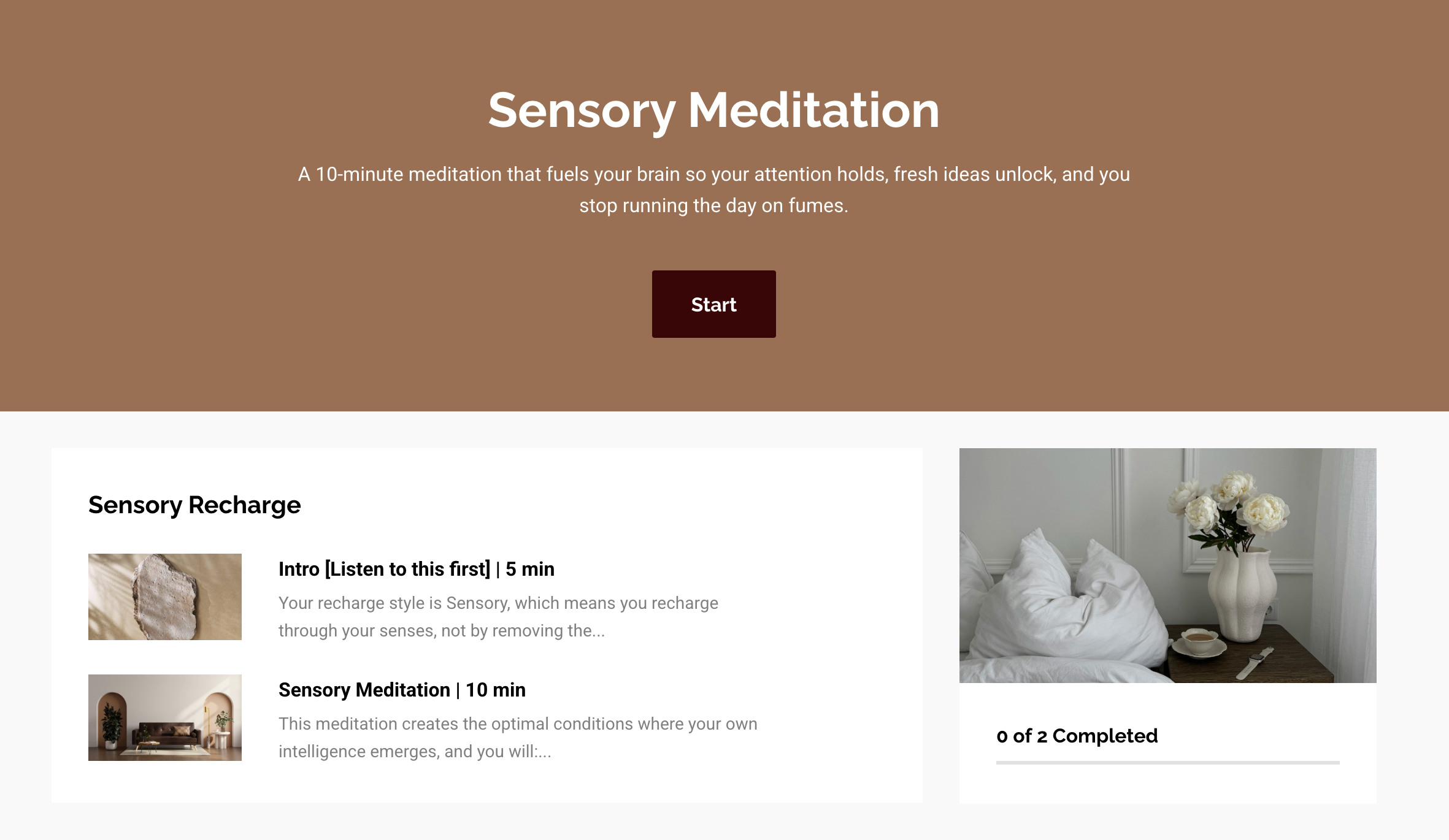
There's a 10-minute audio that does this.
What happens when you press play on your Sensory Audio?
- You recover from stress or exhaustion faster. You build bounce-back, and that makes your mind more plastic, more flexible. (Like when a kid falls and doesn't break a bone, you want a high-plasticity nervous system, not a brittle one. This helps you avoid the mental and emotional osteoporosis that quietly makes you less capable than you used to be.)
- You see the details inside the big-picture before making decisions, so you read risk accurately (not bigger, not smaller) and choose from clarity instead of fog or fear.
- You get the "aha" moment, a business answer or a creative angle that usually only shows up in the shower or right before bed.
- Your present-moment attention sharpens, so you absorb what you're doing or reading better, process more in less time, and regulate what you perceive more cleanly.
- You start the necessary tasks you don't want to do because you get a fresh breath of mental air.
- You finish something and actually let it go, instead of keeping it half-running in the background while you try to do the next thing.
The Sensory Audio gives your brain back its usable energy in the moment you need it most.
How do we do it?
With a 10-minute meditation built on:
- Digesting the background tasks that create the feeling of accumulation, guilt, and quietly erase the progress you actually made.
- Releasing stuck energy or stored stress through targeted oxygenation and a fire-in-your-chest sensation using a specific method that activates courage from the tensioned body and releases a river of ideas and possibilities aligned to you. Think of the relief of finally crying when you needed to, versus the feeling of cry stuck in your throat.
- An injection of fresh energy and ideas by feeding your style's specific fuel in minutes — using directed imagery, shamanic technique, and light music with subconscious-pattern waves.
Designed to give you immediate relief, protect your attention, and return usable energy to your brain in the moment you need it.
I want thisBuilt for the 10 minutes you actually have.
Not the 10 minutes you've been meaning to find since January.
The 10 minutes between brushing your youngest's teeth and loading the dishwasher.
The 10 minutes in the car after pickup, before you walk back inside the house.
The 10 minutes between closing the laptop and starting dinner.
The 10 minutes after the bedtime door finally clicks shut and one of the little one comes out asking for water.
Press play.
Keep moving if you want, your hands can be in the dishwasher.
Your eyes can be on the kid.
The audio isn't asking you to sit still, close your eyes, or "find a quiet space."
Sensory-Sensitive women don't always have quiet spaces.
This 10 minute practice knows that.
What it is asking you to do is one specific attentional move, guided, 90 seconds in, that re-anchors the channel your wiring runs on.
The other 8.5 minutes lock the anchor in place.
That's the mechanism.
That's what the wellness internet's 10-minute breathing exercises don't do for your style, they relax the body without re-anchoring the attention, which is why you finish them feeling calmer but still scattered when it comes to what you need to get done.
This audio does the opposite.
You'll not only feel relaxed when it ends, you'll feel located.
And located is what Sensory-Sensitive women have been chasing the whole time.
If your goals are big, your brain can't be running on back-up energy.
You can't build something ambitious on low fuel.
First you charge the system.
Then you execute.
Otherwise everything costs you double the time, double the money, and triple the frustration.

And before you close this tab.
You don't have to use this only when you're already drained.
You can also use it preventively.
Meaning: when your attention and energy are already good but you want to fill the reserve even more, or you know that in a few minutes you're walking into an important meeting and you want clarity, presence, and firm confidence, not the shaky kind.
Because you can't be making $1,000,000 decisions with a month-to-month brain.
Or you can't truly connect with your deepest desires, with the people you love, or with the small poetic moments of the day that slip past you when your attention won't center.
The cost isn't just that you're tired. It's the quality of the ideas and decisions that build what you want, when you're not at 100% in the moments where you should be.
Common Questions:
Before you ask me, read below. If I don't answer your question, my team is more than happy to help you and make this a pleasant, light, and straight-to-the-point experience at [email protected]